


Introduction: The Cost of a Bad Supplier Is Not the Price You Paid
In 12 years of cross-border trade, I have seen dozens of importers negotiating difficult unit prices and losing more money on everything after purchase orders. Invoice is the smallest number in the relationship. In the following months, a large number of people lived in warehouses waiting for machine containers of electric brush motors that would never be shipped. Technicians were unable to read the wiring diagram because they did not provide it, and customers cancelled duplicate orders because the second batch did not match the first batch. The unnecessary losses caused during the procurement process are often overlooked but come at a significant cost.
This is the part of supplier evaluation that most buyers underweight. They evaluate the product, and they treat the supplier as an interchangeable delivery channel for that product. That is a mistake, because in industrial cleaning equipment, the supplier is not a channel. The supplier is the warranty, the parts department, the technical support desk, and the continuity of the product line itself.
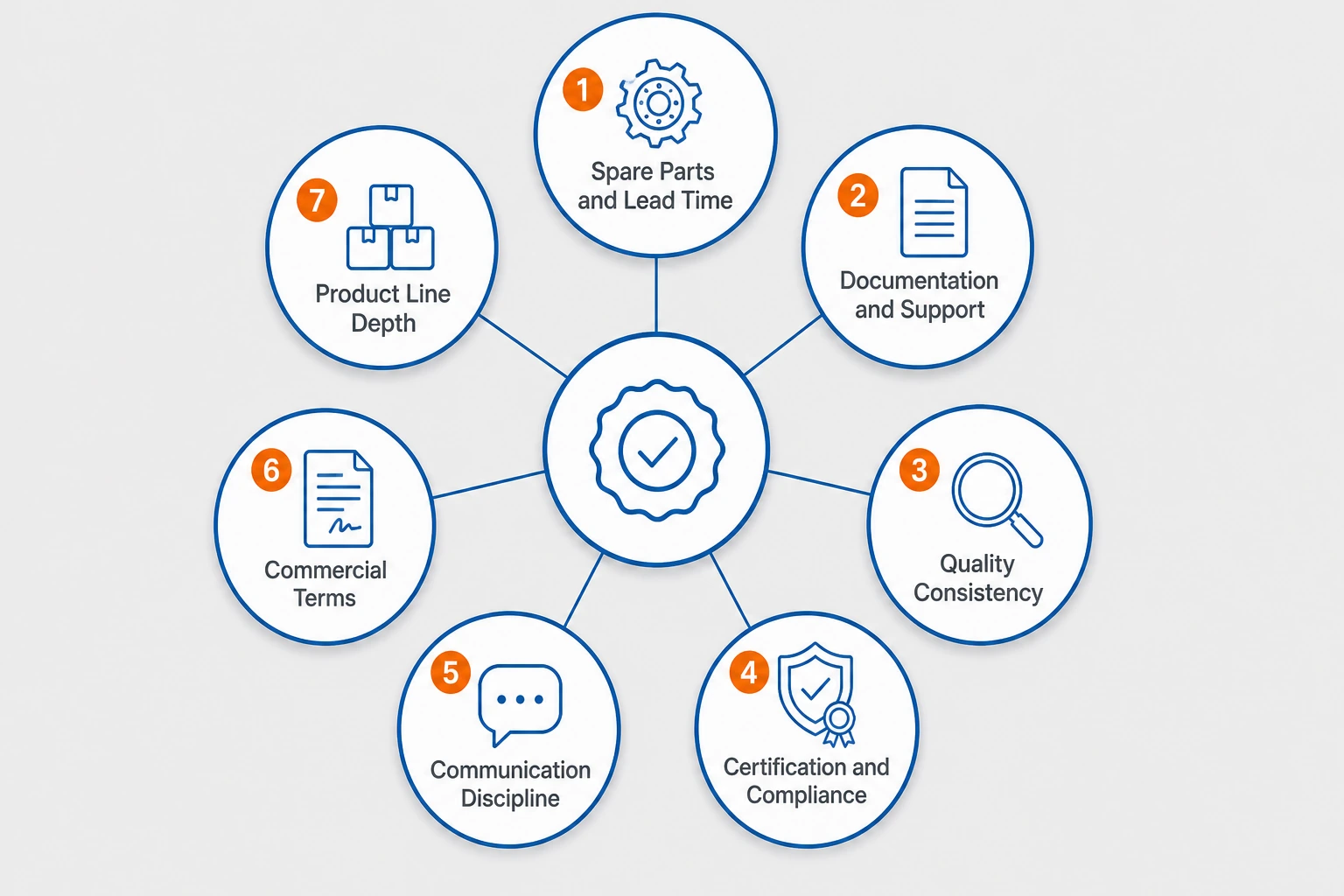
This guide is the checklist I use when I evaluate a manufacturer on behalf of an importer, a distributor, or a facility procurement team. It is organized around seven criteria, followed by a scorecard you can apply to any supplier in the category.
Section 1: Why Supplier Selection Outranks Product Selection
Let me state the principle plainly. In low value commodity categories, you can evaluate the product and accept almost any supplier, because the cost of a failed order is capped at the order value. Industrial cleaning equipment does not work that way. A ride on scrubber or sweeper is a five to ten year asset with consumable parts, seasonal maintenance, and a service life measured in thousands of operating hours.
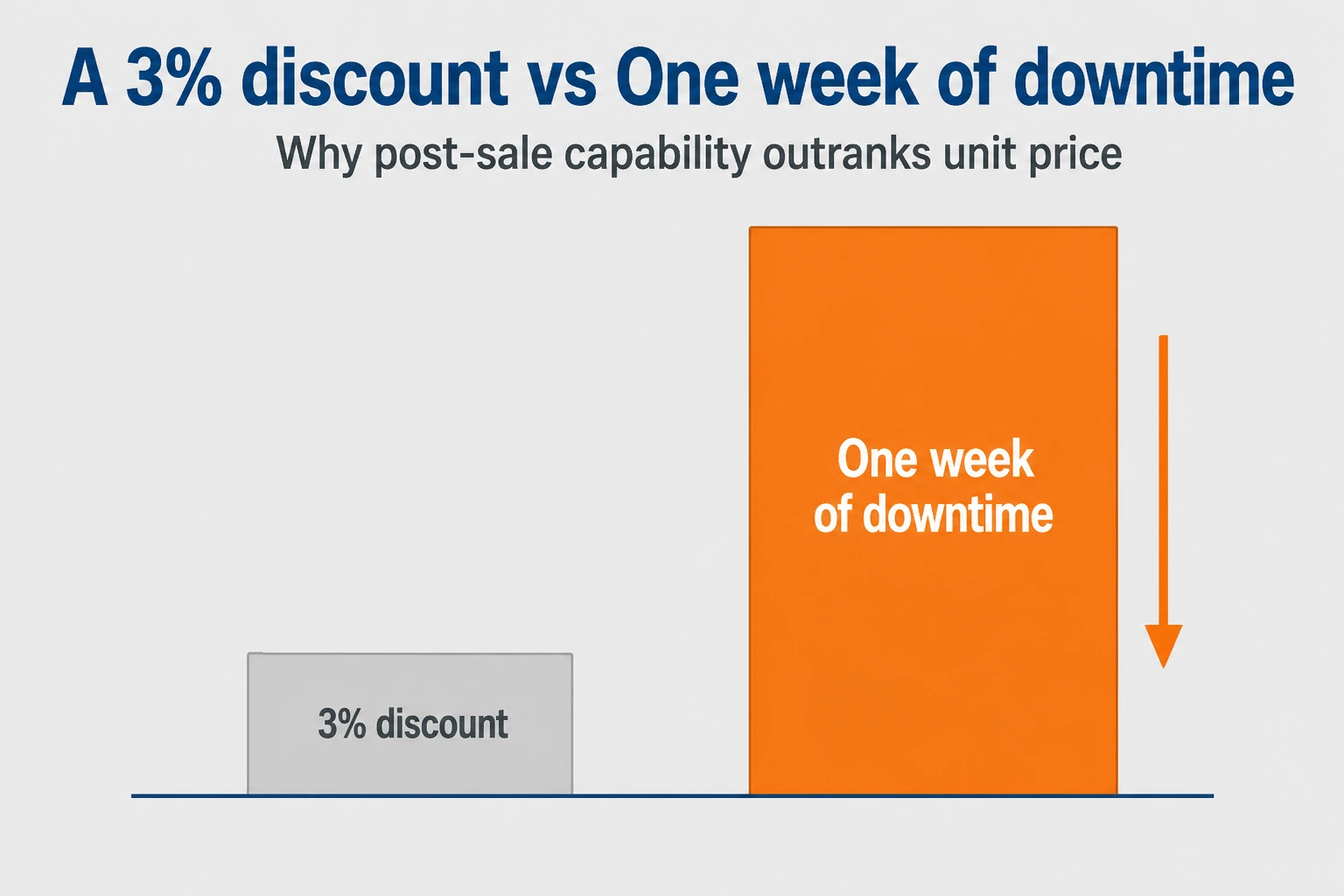
When the asset fails on the 400th day, the buyer is not concerned about the 3% price advantage they negotiated at the beginning. They are concerned about how quickly replacement parts can arrive, whether the malfunction has been resolved, and whether anyone from the supplier can remotely diagnose the problem. The value of suppliers is only realized after sales, which is why the selection of suppliers must be evaluated based on their after-sales capabilities, not just the initial quotation.
[Kairos's Insight: I ask importers one question to expose the real risk, what is the daily cost of the machine standing still? For a facility cleaning a supermarket or a distribution center, downtime is not an inconvenience, it is a compliance and safety problem. A single brush motor delay can cost more than the entire margin on the original container. That math is the reason spare parts logistics deserve more attention in the supplier evaluation than the unit price.]
Section 2: Criterion One, Spare Parts Availability and Lead Time
Spare parts are the single most revealing criterion in supplier evaluation, because they expose how the factory is actually organized. A manufacturer that sells machines without a parts system is selling you a future problem.
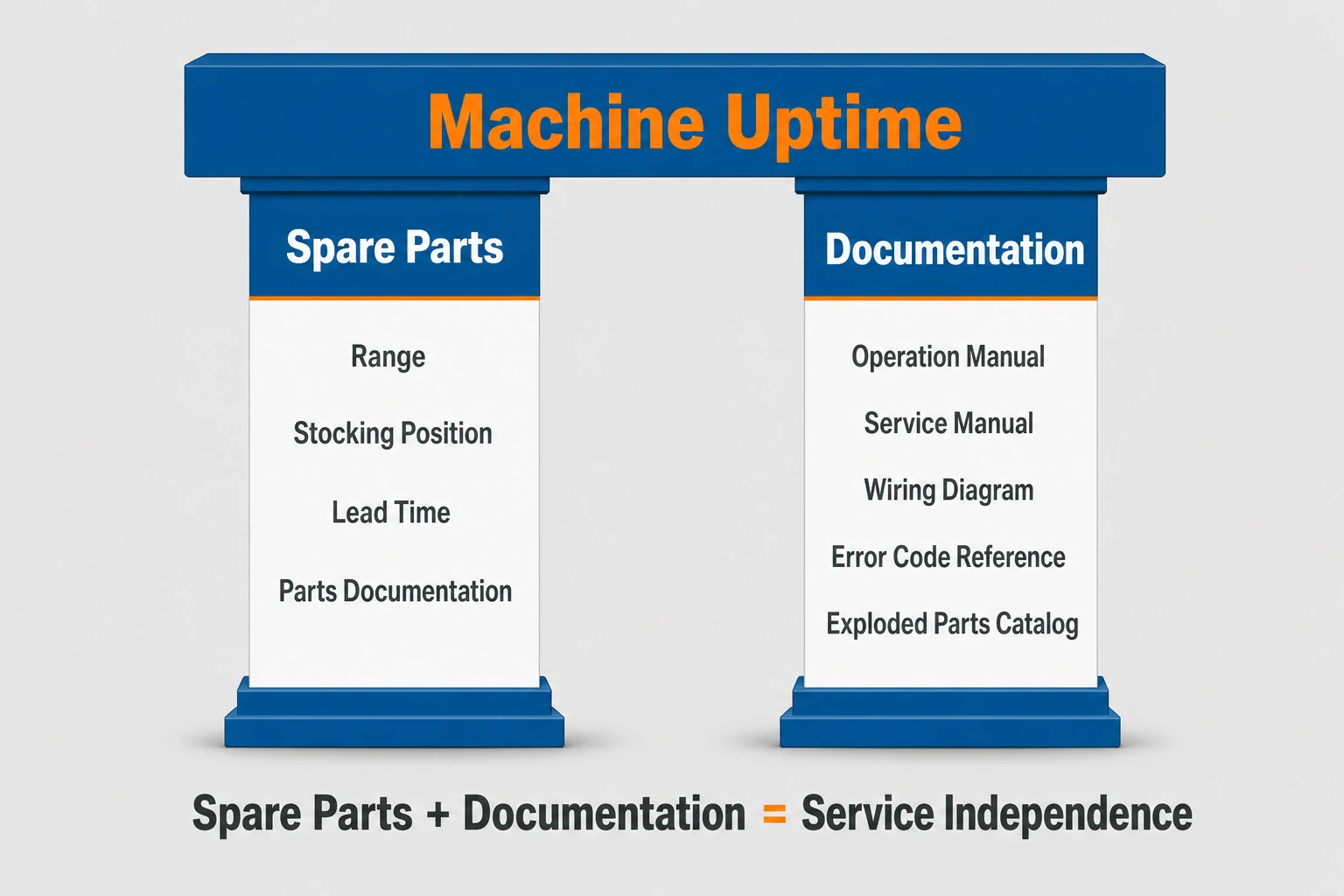
Evaluate the parts capability on four dimensions. First, the range. Ask for the complete spare parts list, and check that it covers the motor assemblies, brush discs, squeegee blades, batteries, control boards, and the wear parts that will actually fail in service. Second, the stocking position. Ask which parts are held in inventory and which are made to order, because a made to order part can add weeks to a repair. Third, the lead time commitment. Get a written standard lead time for critical parts, and ask what happens when the part is out of stock. Fourth, the documentation. A parts list with part numbers is not optional, because without it, the buyer cannot order the correct part even when it is available.
In categories where the machines run daily, such as supermarket floor care or warehouse sweeping, I recommend that importers carry a small strategic parts stock rather than depending on express shipments for every failure. That stock is cheaper than a single week of downtime.
Section 3: Criterion Two, Technical Documentation and After Sales Support
Technical documentation is the criterion that buyers most often overlook and most often regret. A machine without documentation is a machine that can only be serviced by the supplier, which converts the buyer into a permanently dependent customer.
Request the full documentation package and evaluate it carefully. You want an operation manual in the target market language, a service and maintenance manual, an electrical wiring diagram, a hydraulic or mechanical schematic where applicable, an error code reference for any machine with a control system, and a parts catalog with exploded views. If the supplier cannot produce a wiring diagram for an electric ride on machine, that is a signal about the depth of their engineering capability, not just about their paperwork.
Then evaluate the supporting structure behind the document. Ask who is answering technical questions after sales, whether there are engineers who can perform remote diagnosis, whether video call support can be provided for debugging, and whether training is provided for service technicians of importers. The ability of suppliers to remotely support diagnosis for battery powered machines with control systems is the difference between small faults and expensive machine retrieval.
[Kairos's Insight: I treat documentation as a proxy for engineering maturity. A factory that maintains accurate wiring diagrams, exploded parts views, and error code tables has engineers who understand their own product. A factory that cannot produce these documents is assembling machines rather than engineering them. When I advise distributors, I put documentation review ahead of price negotiation, because documentation determines whether the buyer can build a service business or only a sales business.]
Section 4: Criterion Three, Quality Consistency Across Orders
The prototype is not the product. Every factory can produce an excellent first unit. The commercial risk is in batch two, batch three, and batch eleven, after the original components have been substituted, the tooling has worn, and the quality inspector has moved on.
Evaluate consistency through evidence rather than promises. Ask for the quality control process in writing, including incoming material inspection, in process checks, and final testing before packing. Ask how many units are tested per batch and whether every unit receives a functional test. Ask for the component brand list for critical items such as motors, batteries, controllers, and chargers, and check whether those brands are substituted between orders without notice.
Then verify with history. Ask for records from a production batch that shipped twelve months earlier, and compare the component list against current production. Ask the supplier directly whether any critical component has been changed since that batch. A supplier who answers that question precisely and without hesitation is a supplier who tracks change control.
Kairos' insight: Prototype is never a problem, the eleventh container is the problem. Every factory can build a perfect first unit for important buyers. 18 months later, commercial risks emerged after a car supplier was replaced with a cheaper alternative, after the tooling was worn out, and after the inspector who signed the first batch of products left the company. My first question when importers tell them that the quality of repeat orders has decreased is always whether they have obtained a written list of component brands and change notification terms in the original agreement. Without these two documents, the buyer would not have had the means to test the substitute before the customer complained
Section 5: Criterion Four, Certifications and Market Compliance
Certification is the criterion that determines whether the equipment can legally enter and operate in the target market. It is not a formality, and it is not a document you want to discover is missing after the container has sailed.
Build a market specific compliance list before you speak to the supplier. For the European Union, that includes the CE marking framework, the applicable machinery and electromagnetic compatibility directives, and the electrical safety standards relevant to the product. For North America, it includes the relevant listing and safety standards for the electrical components. For other regions, the requirements vary, and the burden is on the buyer to know them precisely.
Then ask for the certificates themselves, not a claim about them. Verify the certificate is issued by an accredited body, check that the certificate covers the specific model and configuration you are purchasing, and check the validity date. A certificate for a different model in the same family is not a certificate for the machine in your container. Where battery systems are involved, ask specifically about transport documentation for lithium cells.
Section 6: Criterion Five, Communication Discipline Before and After the Order
Communication behavior during the sales process is a preview of communication behavior during the service period. Suppliers rarely become more responsive after they have been paid.
Test this deliberately during the evaluation. Measure the response time to a technical question that requires an engineer rather than a salesperson, not a pricing question. Observe whether the answer is precise or evasive, whether the supplier admits uncertainty, and whether the follow up arrives unprompted. Send a question about an error code or a warranty scenario, and note how many internal handoffs it takes to produce an answer.
Kairos' insight: A supplier answers a difficult technical question in one day and has an engineer in the loop, which is telling you that their after-sales structure exists. A supplier who uses marketing language to transfer this issue, or a supplier who takes a week to respond, is also telling you the same thing about their future service response. I have never seen suppliers reverse this pattern after a purchase order. Measure behavior before placing an order and believe in it
Section 7: Criterion Six, Commercial Terms and Relationship Stability
Commercial terms are not only about price. They define how the relationship behaves over time, and several clauses deserve scrutiny in this category.
Examine the minimum order quantity, because an MOQ that is too high for a pilot order prevents you from validating the product before committing capital. Examine the payment terms, because a supplier who demands full payment before production leaves the buyer with no leverage if the delivery is defective. Examine the warranty terms, including what is covered, what is excluded, who pays return freight on a defective part, and what the claim process requires. Examine the exclusivity and territory structure, because an importer who builds a market for a product needs some protection against the supplier selling directly into that market or appointing a competing distributor.
On territory, a pragmatic approach for both sides is a structured relationship rather than an absolute lock. A good supplier will agree to a defined pilot territory with performance milestones, which protects the importer's investment while giving the supplier a rational basis for exclusivity later.
[Kairos's Insight: When an importer asks me whether to accept a supplier who offers no territory protection and no performance framework, my answer is usually no. A distributor who invests in demonstration inventory, service training, and market development is building an asset that a supplier can capture without cost. Structured territory terms protect the investment on both sides, and a manufacturer who refuses all structure is signaling that they intend to keep all optionality for themselves.]
Section 8: Criterion Seven, Product Line Depth and the Upgrade Path
The final criterion is the one that matters in year three. A supplier who sells a single product line leaves the importer with no growth path, because the importer can only sell what the factory can build.
Evaluate the breadth of the product portfolio and the coherence of its segmented markets. For importers serving facility managers, a useful supplier should cover the entire workflow of floor care, from handheld machines for small sites to ride on devices for large sites, from wet cleaning scrubbers to dry debris sweepers, from manual equipment to market ready automated systems. This product depth enables importers to expand customer relationships rather than reselling individual SKUs.
It is worth noting how a mature manufacturer structures this coverage. A supplier such as CleanHorse, for example, organizes its line by site scale and floor task, with walk behind scrubbers for small commercial spaces, ride on scrubbers for mid size and large facilities, a family of ride on sweepers spanning light to heavy duty classes, dedicated carpet care machines, industrial vacuums, snow management equipment, and autonomous cleaning robots for customers moving toward automation. The buyer does not need every category on day one, but the existence of the roadmap tells the importer that the partnership can grow.
Section 9: The Supplier Evaluation Scorecard
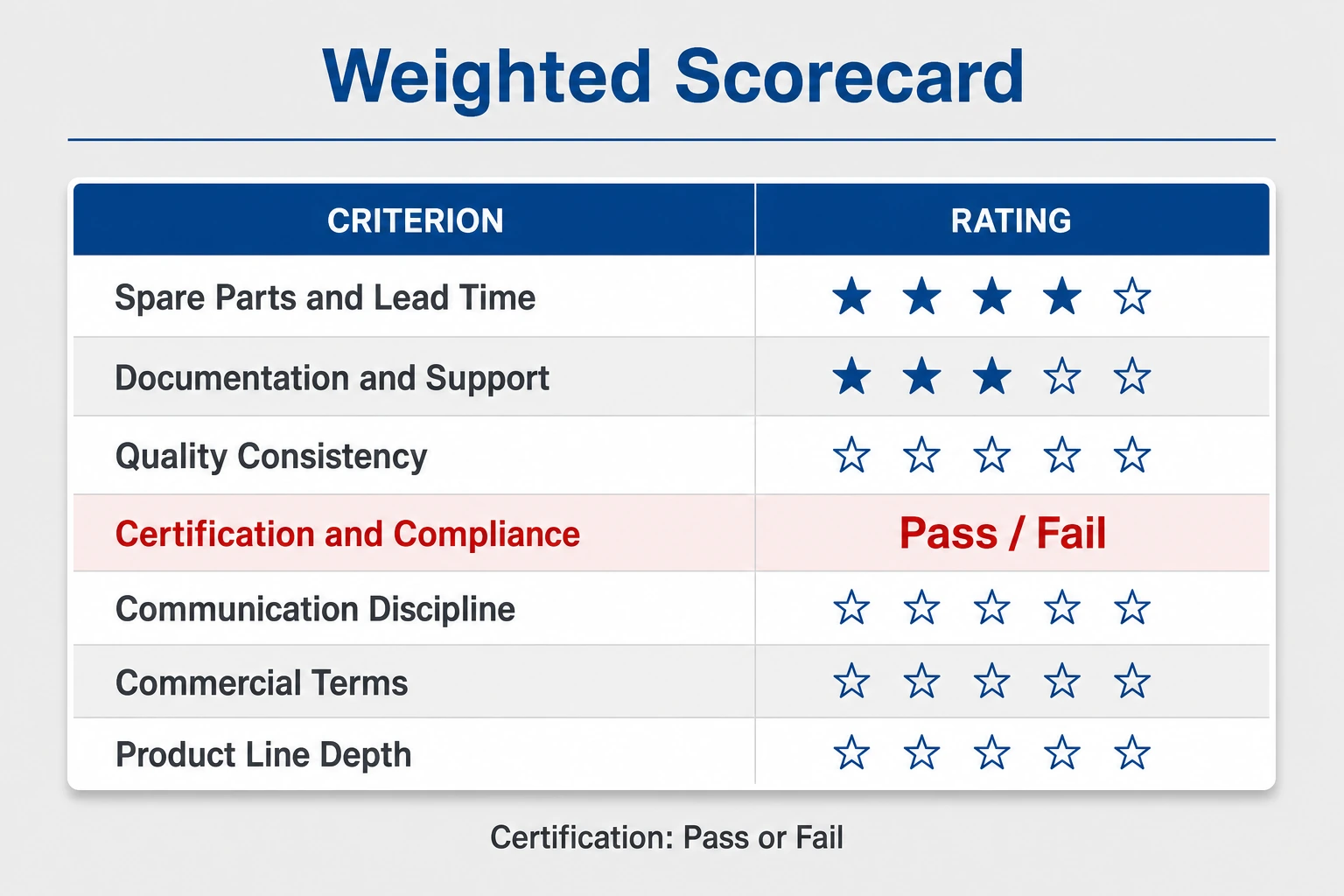
Here is the scorecard I use. Score each criterion from one to five, weight them for your specific market, and reject any supplier that scores below three on a criterion that is critical to your business model.
Criterion one, spare parts. Range of parts, stocking position, committed lead time, and parts documentation. This is the highest weight criterion for any importer planning to offer service.
Criterion two, documentation and support. Operations manual, service manual, wiring diagram, error code reference, and remote diagnosis capability. Weight this heavily if you intend to service machines locally.
Criterion three, quality consistency. Written QC process, component brand control, change control discipline, and batch evidence. Weight this heavily if you plan repeat volume orders.
Criterion four, compliance. Valid certificates for the exact models purchased, issued by accredited bodies, appropriate to the target market. Treat this as a pass or fail criterion in regulated markets.
Criterion five, communication. Response time to technical questions, precision of answers, and unprompted follow up. Use this as a leading indicator for after sales quality.
Criterion six, commercial terms. MOQ appropriate for pilot orders, balanced payment terms, clear warranty including freight responsibility, and structured territory terms.
Criterion seven, product line depth. Breadth of the portfolio, coherence of segments, and presence of a credible upgrade path for the target market.
Run the evaluation before the pilot order, and re run it annually against actual performance. A supplier who scores well in the pitch and poorly in service is a supplier you should have measured on delivery time, not on presentation.
FAQ
1. What is the most important criterion when evaluating a cleaning equipment supplier? For importers and distributors who plan to support the equipment locally, spare parts availability and lead time is the most important criterion. A machine that cannot be repaired is a liability rather than an asset, and the daily cost of an idle machine for a facility often exceeds the margin on the original sale. Evaluate parts range, stocking position, committed lead times, and parts documentation before negotiating price.
2. How can I verify that a supplier's certifications are valid? Ask for the certificates themselves rather than a statement of compliance, confirm the issuing body is accredited, verify that the certificate covers the exact model and configuration you are purchasing, and check the validity dates. A certificate issued for a different model in the same family does not cover your shipment. In regulated markets such as the European Union, treat certification as a pass or fail criterion rather than a scored one.
3. How do I test supplier responsiveness before placing an order? Send a technical question that requires an engineer, such as a question about an error code, a wiring detail, or a warranty scenario on a specific component. Measure how long the answer takes, whether it is precise, and whether the supplier follows up without prompting. Communication behavior before the purchase order reliably predicts service behavior after it.
4. Should I accept the manufacturer's exclusive regional terms? A structured relationship is beneficial for both parties. Clear pilot areas with performance milestones protect importers' investments in demonstration inventory, service training, and market development, while providing a reasonable foundation for manufacturers' future exclusivity. Importers who invest without any territorial structure are establishing an asset that suppliers can obtain for free.
Conclusion: Buy the Supplier, Not Just the Machine
The products on the quotation are visible parts of the purchase. The suppliers behind it determine whether the equipment will make money in the next decade or become part of the warehouse's liabilities. In industrial cleaning equipment, the difference between good and bad suppliers is not measured by the 3% savings you save on invoices, but by the parts delivered, the charts present, the technical personnel that can be trained, and the product line that can be developed together with customers.
Before placing a pilot order, use the seven criteria and scorecard in this guide, and re evaluate the same criteria based on service reality. Choose a supplier, and when something breaks, you can rely on their structure, because in this category, everything will eventually break, and this relationship is the key to repairing it.


