

Outdoor Snow Sweeper Efficiency: 6 Core Influencing Factors and Their Working Principles
As winter approaches in the northern hemisphere, heavy snowfall is on the way. Snow accumulation on roads can seriously affect both travel
and safety.
In these conditions, the efficiency of outdoor snow sweepers varies significantly, with cleaning coverage ranging from 2,000㎡ to 8,000㎡ per hour. Efficiency is mainly influenced by equipment performance, environmental conditions, and operating methods.
This article explains six core factors to help users scientifically improve snow removal efficiency.
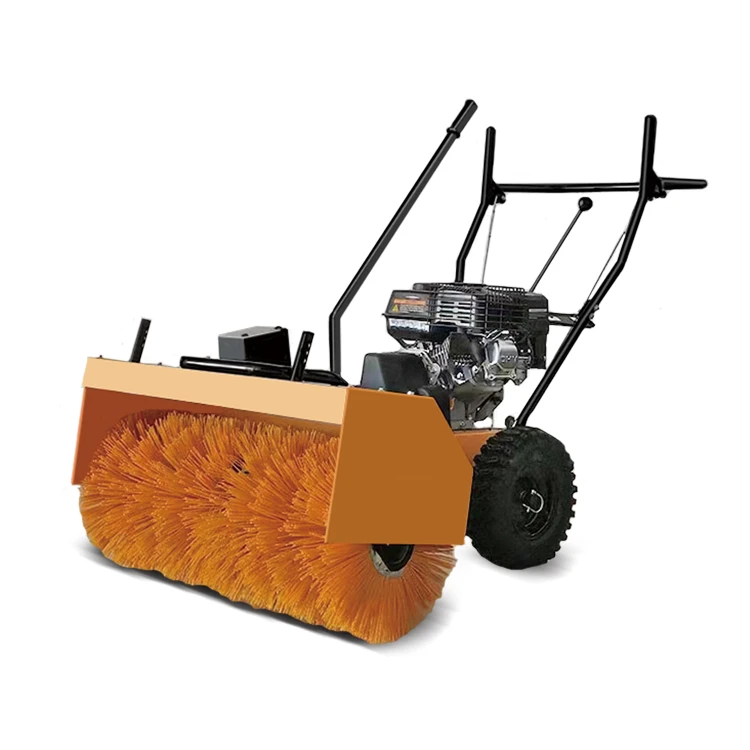
1. Equipment Parameters: The Built-In Basis of Efficiency
1. Engine Power: Power Determines Cleaning Capacity
Snow sweeper engines are typically divided into small (3–5 hp), medium (6–10 hp), and large (11–20 hp):
3–5 hp: Suitable only for thin snow ≤10cm. When clearing 20cm of wet snow, rolling speed drops sharply, cutting efficiency in half.
11–20 hp: Equipped with a dual-stage snow sweeping system, capable of breaking through 30cm of snow or a 5cm ice layer. A 15 hp model can clear up to 8,000㎡ per hour.
Principle: Power determines torque and speed. Insufficient torque makes it difficult to clear thick snow layers, while low speed reduces snow transport efficiency.
2. Working Width and Height: Affecting Cleaning Volume
Width: Brush sizes are generally 50–80cm (small), 80–120cm (medium), and 120–180cm (large). For example, a 100cm sweeper clears 10㎡ in 10 meters, while a 50cm sweeper must travel 20 meters to clear the same area-halving efficiency.
Height: Most machines handle snow depths of 20–50cm. If snow exceeds this height, it must be cleared in layers. Using a 25cm sweeper on 40cm snow requires two passes, reducing efficiency by ~40%.
Note: An 80cm model is more suitable for narrow passages (1.2m wide). Larger machines are harder to maneuver and more likely to jam.
3. Snow Throwing Distance and Angle: Reducing Secondary Labor
Distance: Small machines throw snow 5–8m, medium 8–15m, and large 15–25m. Shorter throwing distances often require additional manual handling, which wastes time and reduces efficiency.
Angle: Adjustable models (0–90°) adapt to different scenarios. Fixed-angle models may require detours when encountering obstacles, adding ~40 minutes per 1,000m of road.
2. Snow Characteristics: Environmental Factors That Determine Difficulty
1. Snow Thickness
The thicker the snow, the lower the efficiency:
≤10cm thin snow: A medium-sized machine at 3–5 km/h can clear ~5,000㎡ per hour.
10–30cm thick snow: Must slow to 2–3 km/h, efficiency drops by 30–40%.
≥30cm thick snow: Requires layered cleaning. For 30cm snow, one job takes ~1.5 hours, reducing efficiency by ~33%.
Principle: Thick snow increases resistance. If power is insufficient, the only option is to reduce speed.
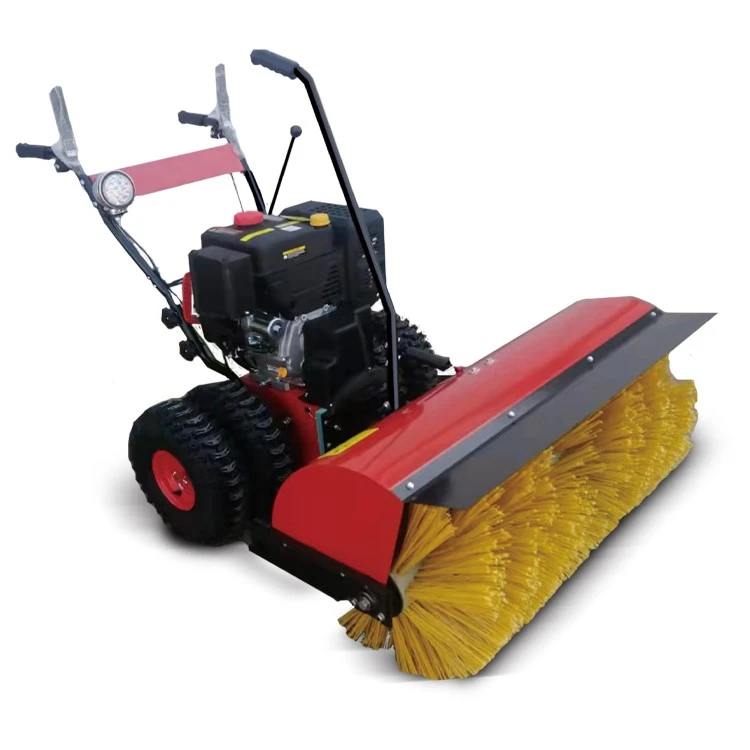
2. Snow Density: Wet Snow is Three Times Harder to Clear Than Dry Snow
Dry snow (≤0.2 g/cm³): A medium machine can clear ~6,000㎡ per hour.
Wet snow (0.2–0.4 g/cm³): Easily clogs the thrower; cleaning must stop every 10 minutes. Effective cleaning time is only ~40 minutes per hour.
Compacted snow (≥0.4 g/cm³): Without ice-breaking teeth, the machine can only push snow, clearing ~1,000㎡ per hour-just 1/6 the efficiency of dry snow.
Example: A 10 hp model clears dry snow at 5 km/h, wet snow at 2 km/h, and compacted snow at 1 km/h-a fivefold difference in efficiency.
3. Snow Impurities: Stones, Branches, and Other Obstacles
Snow sweepers often encounter stones, branches, or plastic bags that jam the brushes. Each stoppage can take ~30 minutes to fix.
Recommendation: Manually remove large debris in advance, and choose models with filter screens in areas where stones are common.
3. Operation and Maintenance: Human Factors That Maximize Efficiency
1. Operation Method: Speed and Route Planning
Going too fast: For medium/thick snow, 5 km/h leaves residual snow that requires re-cleaning. Adjust speed to snow type: 3–5 km/h for dry snow, 2–3 km/h for wet snow.
Poor route planning: Without a planned route, 20% of the area may be cleaned twice. Using straight-line cleaning with 10–15cm overlaps can save ~1 hour for a 10,000㎡ square.

2. Equipment Maintenance: Poor Condition Cuts Efficiency by Half
Brush wear: Efficiency drops 30% when bristles wear from 5cm to 3cm, and 50% when worn to 2cm.
Oil issues: Insufficient or deteriorated oil reduces power by 10–20% and may cause 2–3 breakdowns per hour.
Residual snow blockages: Unremoved snow can freeze and block the machine, with each clearing taking ~20 minutes.
Recommendation: Inspect brushes and engine oil before and after use, and remove any snow buildup promptly.

Conclusion
The three main factors that determine snow removal efficiency are equipment performance, environmental conditions, and human operation.
Before heavy snow arrives, selecting the right sweeper and becoming familiar with its operation are essential for maximizing efficiency.


