


You use a floor scrubber to clean along a clean epoxy resin aisle (such as the underground garage of Wanda Plaza), waiting for the floor to dry and watching the dull lines and dry marks appear behind you. The floor is technically clean, but it looks worse than before cleaning.
One of the most common complaints we hear from the facility team is that ground marks are caused during the cleaning process of epoxy resin floors, and it is rarely a machine malfunction. This is the mismatch between the way the scraper lifts water, the amount of water you put down, and the amount of water dissolved in it. Perform the following checks in order. Each one is cheaper and faster than the next, and most stripes appear in the first three.
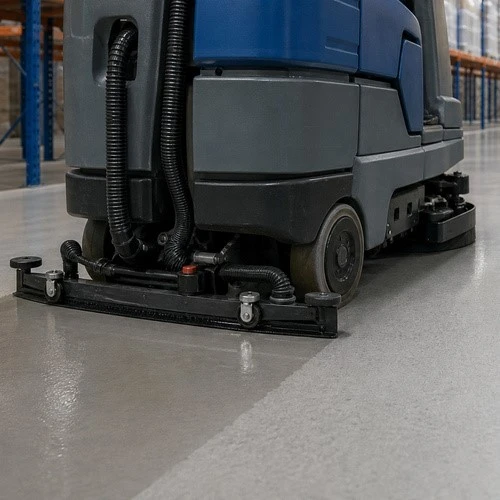
Epoxy Is Unforgiving - Start With the Pick-Up Path
Epoxy is non-porous. Water has nowhere to soak in, so everything you put down has to come back up in the same pass. A squeegee that is "good enough" on concrete will leave a visible film on a sealed floor.
1. Squeegee blade condition
A blade that has lost its sharp trailing edge, hardened with age, or picked up nicks leaves a thin ribbon of water that dries into a line exactly where the seal failed.

Use your nails to swipe along the entire back edge. It should be slightly bent and gripped; If it feels hard or shiny to the touch, it indicates that the rubber has aged and needs to be replaced.
Check for scratches and tears, especially near the end and where the blade meets the frame.
If the blade is reversible, please rotate it to the unused edge before replacement.
The wear of blades depends on the wear resistance of the floor, the strength of the cleaning agent, and the daily working hours. Replacing them on the calendar instead of during inspections will constantly reveal stripes between replacements.
2. Squeegee angle and height
The blade should trail behind the machine and touch the floor evenly across its full width. Two failures are common:
Tips lifting.
Set too high, the outer ends ride off slightly uneven epoxy and leave twin streaks at the edge of every pass.
Blade digging in.
Set too low or tilted forward, the rubber chatters and skips, leaving a stuttered pattern rather than a clean line.
Lower the squeegee on a dry section and pull the machine backward slowly by hand. You should feel even resistance across the whole blade, with no gaps at the ends.
Adjustment points differ by model. Follow the adjustment section in your machine documentation rather than forcing the linkage. [
3. Water flow and pass speed
On a sealed floor, excess water is the most common cause of "the scrubber is leaving streaks" complaints. The squeegee can only recover so much water per second. Put down more than that, or drive faster than that, and the surplus stays behind as a film that dries unevenly and shows every wheel line.
Reduce solution flow before changing anything else - on machines with intelligent water control, check the set point, not just the automatic mode.
Slow the pass: the squeegee gets more time to seal, the vacuum more time to lift.
On soiled epoxy, two lighter passes beat one heavy wet pass.
Practical test: run one pass at current settings and watch the floor immediately behind the blade. If water is still visible as a continuous sheet more than a second later, you are putting down too much.
4. Solution chemistry and residue
A scrubber removes only what the chemistry releases. Two residue problems produce streak-like patterns:
Wrong dilution.
Too strong leaves a surfactant film that dries to a haze with tide marks at pass boundaries; too weak smears soil instead of lifting it.
Old or contaminated solution.
Detergent left standing, or a tank rinsed rarely, carries soil and biofilm back onto the floor every pass.
Mix to the label dilution, dump and rinse the solution tank each shift, and add defoamer only when the product calls for it - not as a habit.
5. Recovery tank, float, and hose
If the machine stops lifting water mid-pass, the vacuum path is restricted: tank full or foam-covered, float tripped, hose kinked, squeegee port blocked, or a drain fitting not sealed.

This failure has a useful signature - streaking that starts suddenly mid-shift points to vacuum, while a gradual onset points to blade wear or chemistry.
A 10-Minute Diagnostic Sequence
|
Step |
Check |
Pass criteria |
If it fails |
|
1 |
Recovery tank level and float |
Under half, float free, no foam blanket |
Empty, rinse, add defoamer only if specified |
|
2 |
Vacuum hose and squeegee port |
No kinks, no debris, fittings sealed |
Clear obstruction, reseat connections |
|
3 |
Squeegee blade edges |
Flexible, no nicks, edges serviceable |
Rotate or replace blade |
|
4 |
Squeegee contact across full width |
Even resistance, tips touching, no chatter |
Adjust height and angle per manual |
|
5 |
Solution flow setting |
Thin even film, no standing sheet behind blade |
Reduce flow and pass speed |
|
6 |
Dilution and tank cleanliness |
Mix matches label, tank rinsed this shift |
Remix, rinse tank |
Run the sequence in order. If the streak disappears at step 2 or 3, you have found it without touching chemistry or machine settings.
Matching the Machine to the Floor
Streaking is sometimes a machine-fit problem, not a maintenance problem. A wide ride-on scrubber is efficient in open aisles, but in narrow retail runs and around racking it is often operated at a pass width and water volume the floor cannot absorb cleanly.

Open warehouse and plant aisles:
ride-on platforms - ARES510 / ARES530 / ARES550 / ARES700 / ARES710, or the X4 / X5 / X6 - with dual-brush decks and high-capacity recovery tanks.
Retail, hospital corridors, food service, mixed floor zones:
walk-behind and self-propelled units - X1 / X2 / X3 - where the operator controls pass width and speed tightly.
Small footprints and back-of-house:
Mini K1–K5 and Compact H10 / H20.
No class is inherently better. What matters is whether the pass you can actually control - width, speed, water volume - lets the squeegee finish the job on a sealed floor.
Keeping Streaks From Coming Back
|
Frequency |
Task |
Why it matters on epoxy |
|
Every shift |
Empty and rinse recovery tank; check float |
A foam blanket silently kills vacuum pick-up |
|
Every shift |
Inspect squeegee edge before the first pass |
Wear is progressive and invisible from the seat |
|
Weekly |
Rotate or replace blades; rinse solution tank |
Catches nicks before they become permanent lines |
|
Monthly |
Check squeegee linkage, castors, hose seals |
Small alignment drift appears as edge streaks |
|
Quarterly |
Review chemistry against actual soil type |
Wrong detergent is often mistaken for a worn blade |
Log blade changes and dilution checks. A site that keeps the record can usually trace a streak complaint to a specific date and cause.
Key Takeaway
Most epoxy streaking is a pick-up and water-volume problem, not a power problem - check the squeegee seal and the water you put down before spending money on parts or chemistry.
If your team has worked through this sequence and the floor still dries unevenly, the next step is a floor-and-soil assessment against the machine configuration. Send us your floor type, aisle width, shift pattern, and current model, and our team will recommend the right scrubber class and squeegee setup.
Talk to CleanHorse: WhatsApp / phone +86 17864388016 · Email bryant19961120@gmail.com · Request a Quote
FAQ
Why does my scrubber only streak in some areas of the same floor?
Localized streaking means localized conditions: a patched or re-coated section with a different surface profile, a transition strip where the squeegee loses contact, or a zone where operators naturally drive faster. Mark those areas on a floor plan and check contact there specifically.
Can hard water cause streaks on epoxy?
yes. High mineral water leaves a thin film when evaporating, which appears as a thin mist or white ring at the edges. If the mode follows water instead of machine operation, please test the water source before replacing parts.
Should I use more water on a dirty epoxy floor?
Usually no. More water means more to recover, and squeegee recovery per second is fixed. Two slower passes at reduced flow remove more soil than one wet pass that leaves a film.
My squeegee blade is new and the floor still streaks. What now?
Turn to the vacuum pathway and chemistry. Check the recycling tank, float, hose seals, and actual mixed diluent instead of the diluent on the specification sheet.


